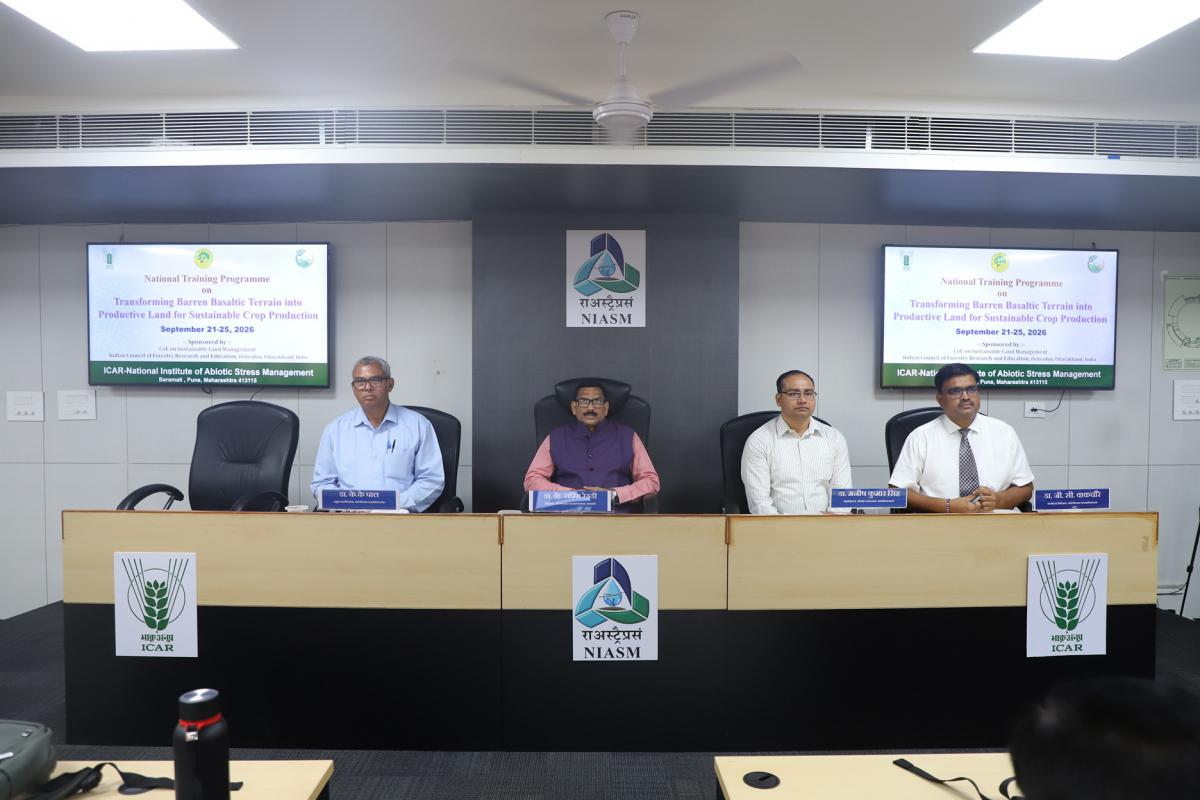
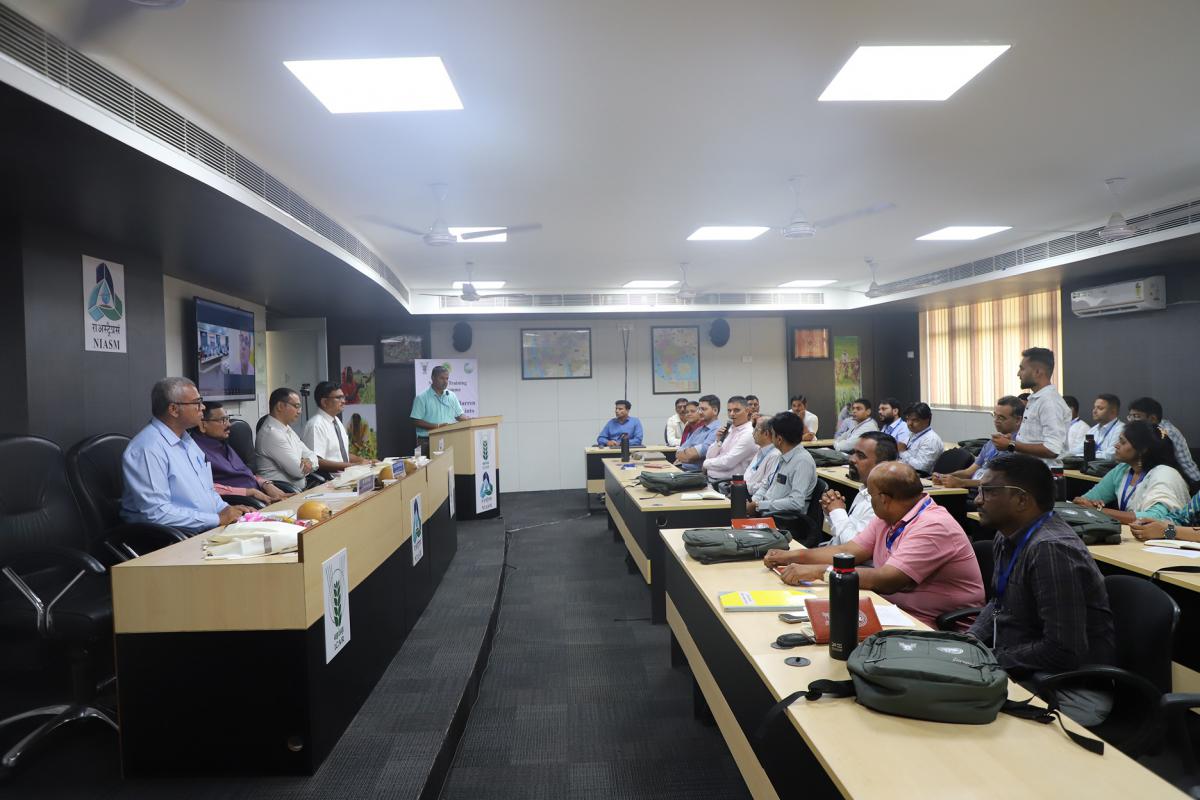
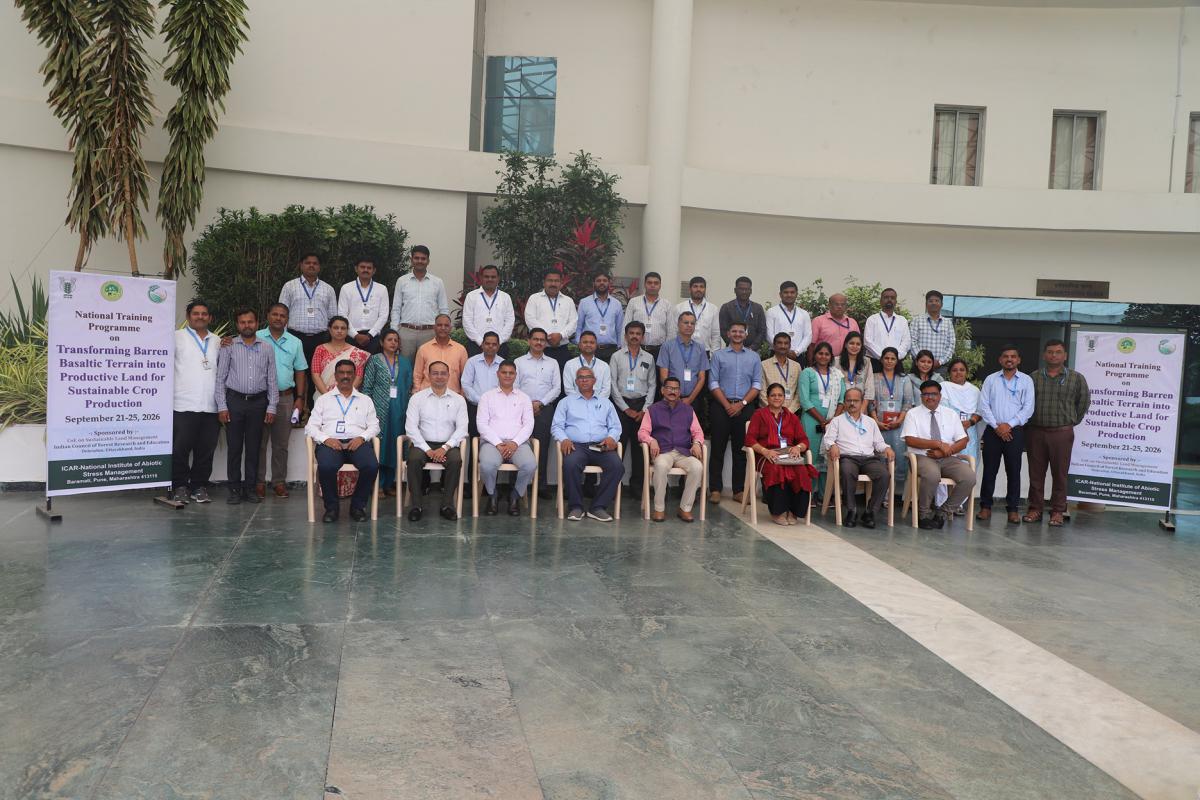
A five-day CoE-SLM, ICFRE-sponsored National Training Programme on “Transforming Barren Basaltic Terrain into Productive Land for Sustainable Crop Production”, being held from 21-25 September 2026, was inaugurated on Monday, 21 September 2026, at the ICAR-National Institute of Abiotic Stress Management (ICAR-NIASM), Baramati, Maharashtra.
The inaugural session was graced by Dr. Rakesh Kumar, Additional Director General (AAF & CC), NRM, ICAR, New Delhi, as the Chief Guest. In his inaugural address, Dr. Rakesh Kumar emphasised the critical need to transform barren and degraded basaltic rocky terrain into productive agricultural land through an integrated land, soil and water management approach. He appreciated the long-term contributions of former Directors, including Dr. Vitthal, Dr. P. S. Minhas, Dr. N. P. Singh and Dr. H. Pathak, as well as the present Director, towards shaping ICAR-NIASM as a national reference centre for abiotic stress management and land restoration.
Dr. K. Sammi. Reddy, Director, ICAR-NIASM, highlighted the role of the Institute in addressing abiotic stresses arising from edaphic, water and atmospheric factors. He elaborated on the technologies developed at NIASM for mitigating abiotic stresses and their demonstration for potential economic and livelihood benefits. He also emphasised the importance of disseminating these technologies among government officials, extension functionaries, researchers, policymakers, NGOs and progressive farmers to enhance practical knowledge and technical skills for sustainable land management and crop production under abiotic-stressed environments.
Dr. K. K. Pal, Head, School of Drought Stress Management (SDSM), highlighted the increasing abiotic stresses associated with climate change and emphasised the need to transform shallow and degraded basaltic lands into productive agricultural landscapes. Dr. Manish Kumar Singh and Dr. Hansraj, Scientists and representatives from the Centre of Excellence on Sustainable Land Management (CoE-SLM), ICFRE, Dehradun, highlighted the role of the Centre in promoting sustainable land management and supporting India’s commitments towards Land Degradation Neutrality under the United Nations Convention to Combat Desertification (UNCCD), along with broader national goals related to climate-resilient agriculture and natural resource management. Dr. G. C. Wakchaure, Programme Director, presented an overview of the training programme, including its objectives, thematic areas and the profile of the participating trainees.
A total of 27 participants from 10 states across India are participating in the training programme. The participants include Class-I officials from various State Government Departments, particularly Forest (IFS), Agriculture, Agricultural Engineering and Horticulture, along with representatives from KVKs, ICAR institutes, SAUs, NGOs and progressive farming communities. The participants represent Maharashtra, Madhya Pradesh, Tamil Nadu, Bihar, Haryana, Rajasthan, Uttar Pradesh, Chhattisgarh and Punjab. Women participants constituted approximately 22% of the total participants.
The training programme aims to bridge knowledge gaps, strengthen technical competencies and promote integrated interventions encompassing site characterisation and planning, engineering interventions, soil fertility restoration, water resource development and climate-smart farming systems for sustainable land management. It provides participants with practical knowledge and hands-on skills to plan, implement and manage land transformation technologies for sustainable crop production under climate-stressed environments.
The organising team comprising Dr. Prashantkumar Hanjagi, Dr. Paritosh Kumar, Dr. Sushma Awaji and Dr. D. D. Nangare deserves appreciation for their dedicated efforts in organising the inaugural programme successfully.